
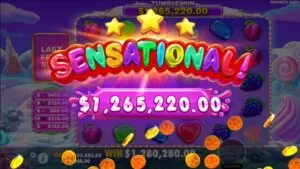
Sweet Bonanza is built around a tumble mechanic that can turn one paid spin into several consecutive winning stages. For Canadian adults comparing the sweet bonanza game, understanding that sequence matters more than its colourful presentation. A tumble does not create a guaranteed result or remove the normal risk attached to a slot. Instead, it changes how winning symbols are cleared, replaced and assessed during the same spin. The practical questions are when a tumble begins, how long it can continue, and how the free-spins version changes the calculation.
What exactly happens after a winning combination?
The base game uses a 6×5 grid with 30 symbol positions and a Pay Anywhere system. There are no traditional fixed paylines to follow. A qualifying win is formed when at least eight matching paying symbols appear anywhere on the grid. The exact location of those symbols matters less than the total number present, so a cluster spread across several rows can still qualify.
Once a winning group has been identified, those symbols disappear from the grid. The symbols above them fall into the empty spaces, and new symbols enter from the top. This movement is the tumble. The replacement symbols are then checked for another qualifying combination, still within the same paid spin. If another win appears, it is paid and cleared in the same way.
The process ends when the latest arrangement produces no new winning combination. Wins formed during separate stages of one tumble sequence are added together for that spin. This is important because the final result is not necessarily visible in the original grid. A modest first win may be followed by additional combinations after symbols drop, although no particular number of tumbles is promised.

How should players read the win sequence?
A useful way to follow a tumble is to separate three events: the qualifying symbols, the cleared spaces and the replacement symbols. The first event determines whether the sequence starts. The second creates room for new symbols. The third determines whether another win is possible. Watching the animation is entertaining, but it is the completed sequence and its displayed total that matter for the spin’s result.
Several winning groups can appear in one grid arrangement. They may involve different symbols, and their awards are combined before the next tumble begins. A large number of matching symbols can therefore produce more than one award in the same stage. It is still essential to distinguish a larger displayed win from a higher chance of a future win: the former is an outcome, while the latter is not guaranteed.
The feature also does not mean that every spin will produce a chain. Many spins can finish after the initial assessment, and some can produce no qualifying combination at all. Short sessions or a few observed rounds cannot establish the slot’s long-term return, volatility or typical tumble length. The information screen for the version being played is the appropriate place to check the applicable rules and RTP configuration.
Which parts of the feature belong to free spins?
The lollipop is the Scatter symbol, and four or more Scatters trigger the built-in Free Spins feature in the documented original version. Four, five and six Scatters also provide a direct Scatter payout before the bonus round begins. The round normally starts with 10 free spins, while three or more additional Scatters can award five extra free spins.
Multiplier bombs are associated with the Free Spins feature rather than ordinary base-game tumbles. Each bomb carries a random value from 2x to 100x. Bombs remain on the grid until the current tumble sequence has finished. Their values are then added together, and the combined multiplier is applied to the win from that sequence.
That timing can be misunderstood. A bomb does not necessarily multiply one symbol or one small award as soon as it lands. Its value is collected with other bombs present during the same active sequence, after which the resulting multiplier is applied according to the game rules. Retriggers, bomb values and tumble outcomes remain random, so entering free spins changes the feature rules but does not guarantee a profitable result.
What can change between casino versions?
The underlying tumble design may be recognisable, but the version loaded at one operator can differ from another in important details. Casinos control the enabled configuration, stake denominations, account currency and availability of optional features. Published RTP figures for the original slot have included configurations around 96.48% to 96.51%, but the relevant figure is the one shown in the game’s information screen.
Optional settings can also vary. An Ante Bet or Double Chance-style option may increase the stake by 25% and add more Scatter symbols to the reels, which is documented as doubling the chance of triggering Free Spins naturally. This option disables the Free Spins purchase feature. Where permitted, Bonus Buy may cost 100 times the selected base bet, but an operator or local rules may disable it.
These choices should be treated as separate costs and conditions, not as improvements that guarantee better returns. Before selecting an option, check the displayed stake, RTP, feature price and any warning or confirmation screen. For general online safety while using a casino website, the Canadian Centre for Cyber Security’s guidance offers practical advice about protecting accounts and personal information.
How can a player assess the feature without overreading it?
Begin by checking the in-game rules rather than relying on a review or a remembered version. Confirm the minimum matching group, Scatter requirement, free-spin award, retrigger rule, multiplier range and applicable RTP. Also check whether the loaded game is the original title rather than a later separate release with a similar name. Different editions can use different mechanics and maximum-win descriptions.
Next, decide whether optional features fit the intended stake. A higher-cost Ante setting changes the price of every spin, while Bonus Buy can require a substantial multiple of the base bet. Neither option removes variance. If the purpose is simply to understand the mechanics, a demo mode may show the interface using virtual credits where the hosting website provides one, but demo play cannot verify real-money performance.
Finally, keep the tumble feature in perspective. It creates the possibility of repeated wins within a single spin, yet it does not make losses recoverable or turn gambling into income. Use the operator’s own account controls for deposit, loss, session or self-exclusion limits, since those tools are not controlled by the slot. Keep records of the amount and time spent, and stop if the session no longer feels recreational.
Questions players often ask
Can one tumble sequence contain several wins?
Yes. After each winning group disappears, replacement symbols can create another qualifying combination. The process may repeat until the new grid produces no further win. All qualifying wins from that sequence are added to the same paid spin, but the number of stages and the final amount are random.
Do multiplier bombs appear during ordinary spins?
In the documented original version, multiplier bombs appear during Free Spins, not during the ordinary base game. Their values range from 2x to 100x, and values present during one active tumble sequence are added together before the resulting multiplier is applied to that sequence’s win.
Is Bonus Buy part of the tumble feature?
No. Bonus Buy is an optional way to enter the 10-spin Free Spins round where the operator and applicable rules allow it. It is separate from the tumble process itself and may be priced at 100 times the selected base bet. Availability and cost should be checked in the loaded game.